Volleyball Line Venti Cup Wrap SVG
First Impression: Clean, Sporty, and Surprisingly Versatile
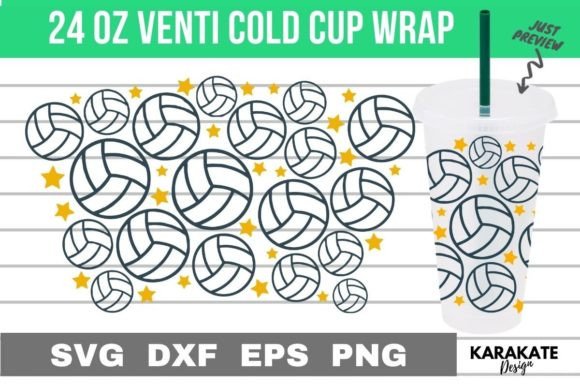
Opening the Volleyball Line - 24 Oz Venti Cup Wrap SVG files, I immediately noticed how purpose-built this design feels—not just for cups, but for any clean, modern craft business looking to celebrate team spirit without clutter. It’s a linear, rhythmic motif: interlocking volleyball seams rendered as bold, continuous strokes with subtle curvature. No heavy fills, no tiny gradients—just confident negative space and balanced line weight. That makes it breathe well on fabric. As an embroidery designer who’s stitched everything from baby onesies to boutique aprons, I appreciate when a graphic doesn’t fight the needle. This one doesn’t. It leans into simplicity, which means fewer stitch complications and stronger visual impact at real-world sizes.
Where It Shines: From Tote Bags to Team Gifts
I tested Volleyball Line - 24 Oz Venti Cup Wrap SVG on a natural canvas tote bag first—hooped with medium tear-away stabilizer, using 40-weight polyester thread in navy and white. The result? Crisp, legible, and instantly recognizable. Because it’s a wrap-style layout, it adapts beautifully to curved surfaces: I resized it slightly and stitched it across the front chest panel of a unisex sweatshirt—and it flowed naturally over the seam without distortion. It also worked cleanly on a cotton tea towel (with light cutaway stabilizer), where the open lines kept the fabric soft and washable.
For Etsy sellers or small shop owners, this is low-risk, high-recognition design territory. Think: custom volleyball camp gifts, school spirit merchandise, coach appreciation bundles, or even nursery decor for a sporty-themed baby shower. I embroidered a scaled-down version onto a cotton twill cap—using a smaller hoop and reducing stitch density slightly—and the clean lines held up. No puckering, no thread breaks. That’s rare for a design that reads so well at both 3" and 6".
Where to Pause: Texture, Scale, and Fabric Realities
That said, Volleyball Line - 24 Oz Venti Cup Wrap SVG isn’t magic—it’s still a line-based embroidery file, and its performance depends heavily on your setup. On highly textured fabrics like thick terry cloth or bouclé knit, the fine continuity of the lines can blur. I recommend testing on scrap first, especially if you’re stitching on stretchy fabric (like performance tees) or dark garments where thread contrast matters more. A black-on-black execution won’t read unless you add a subtle satin stitch outline—or switch to a fill-stitch variant (which this SVG doesn’t include, so keep that in mind).
It’s not ideal for tiny hoops under 3" without careful scaling. The curve radius and seam intersections need breathing room; compressing too far risks losing definition in corners. And while it’s great for patches and applique designs, avoid layering it directly over seams or zippers—those tight curves demand precise hooping and stable backing. For baby embroidery or holiday embroidery projects where softness is non-negotiable, use lightweight stabilizer and skip dense underlay.
What It Adds to Your Finished Product
This isn’t just decoration—it quietly elevates perception. A hand-embroidered tote with Volleyball Line - 24 Oz Venti Cup Wrap SVG feels intentional, not generic. Customers notice the rhythm, the balance, the confidence in the line work. That translates directly to perceived value—especially for personalized gifts or boutique branding. When used consistently across a product line (say, matching sweatshirts, pillow covers, and kitchen towels), it builds brand consistency without shouting. It’s sporty but refined, energetic but calm—ideal for coaches, PTA groups, or small gyms wanting polished merch without stock clip art energy.
Practical Designer Notes You’ll Actually Use
- Always test first—on the exact fabric and stabilizer combo you plan to use. Line-based embroidery files like this one react differently on cotton vs. poly-blend vs. linen.
- Check thread color contrast before stitching on dark or busy backgrounds. A 300 DPI PNG is great for mockups—but nothing replaces seeing how navy thread lands on charcoal fleece.
- Review stitch density in your embroidery software. This design uses mostly running and satin stitches, but density settings affect drape and durability—especially on items meant for frequent washing.
- Confirm hoop size compatibility. While scalable, the original wrap layout assumes ~5"–7" width. Adjust proportionally—not just by percentage—to preserve curve integrity.
- Inspect small details in your vector editor: look for stray anchor points or overlapping paths that could cause jump stitches or thread nests.
- Test black-and-white mockups to gauge recognition at distance—this design should read clearly even in monochrome, thanks to its strong silhouette.
- Use proper stabilizer: medium tear-away for stable wovens, light cutaway for knits, and no-show mesh for sheer or delicate fabrics.
- Verify licensing before selling finished products or digital embroidery files. Since this is listed as a Graphics product in Crafts, confirm whether commercial use is included—don’t assume.
Final Thought: A Quiet Workhorse, Not a Flashy Gimmick
I’ve reviewed hundreds of machine embroidery designs, and what stands out about Volleyball Line - 24 Oz Venti Cup Wrap SVG is its restraint. It doesn’t try to be everything. It knows its lane: clean, sport-inspired, scalable line art for real makers who value clarity over clutter. Whether you’re an Etsy seller building a volleyball-themed shop, a craft business owner curating summer camp merch, or a hobbyist stitching personalized gifts for teammates, this is the kind of digital embroidery file that earns repeat use—not because it’s flashy, but because it delivers, stitch after stitch, project after project.